#software engineering
All links tagged #software engineering
Makes your AI agent think like the laziest senior dev in the room. The best code is the code you never wrote. - DietrichGebert/ponytail
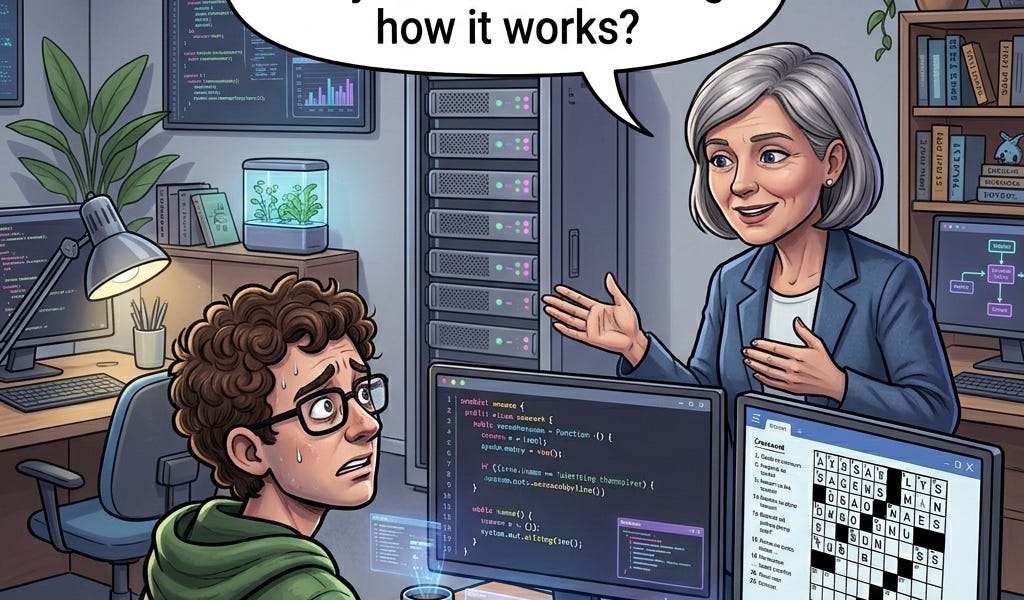
Watch now | There is code running in production right now, at companies you use every day, that nobody can explain.
Here's What Comes Next.
I highlighted the sh*t out of this article! It's not the usual "AI slop = bad" post, it's a fundamental critique of the current staus quo.
If this piece was a conference talk it would get standing ovations.
(Also the first time I ever felt bad for using the freemium service for medium, support the author!)

The anxiety around agents replacing developers misses a fundamental distinction. Writing code is pattern recognition, but software engineering is not.
Agent harness to make your slop code well-engineered and beautiful. - peteromallet/desloppify

16 AI agents wrote a C compiler from scratch. No human touched the code. The result: 100,000 lines of Rust that compiles the Linux kernel on x86, ARM, and RISC-V. Most developers still haven't processed what it means. Here is what actually happened:

Vibe coding represents a shift where the feeling of a product takes precedence over traditional technical rigor.
While high-level AI abstractions allow for rapid prototyping and aesthetic polish, they often mask underlying technical debt and fragile logic.

Linux Foundation’s report reveals that contributing to open source offers a 2x-5x ROI. Learn why private forks create technical debt and how to invest wisely.
Measuring the financial return of open source contributions is notoriously difficult, yet this breakdown offers a pragmatic framework for leaders to justify upstream engagement. It moves beyond vague notions of "giving back" to highlight how reduced technical debt and faster hiring cycles directly impact the bottom line.
By treating code as a strategic asset rather than a cost center, you gain influence over the roadmap of tools your business relies on every single day.
Or you can just fork the software and deal with the constant struggle of adjusting the codebase of your legacy codebase with updates.
Boris Cherny, the founder of Anthropic's Claude Code, said AI has largely solved coding, so software engineers will start to take on different tasks.
Boris Cherny, Anthropic's Claude Code founder, declares coding "practically solved" by AI, predicting the "software engineer" title fades by 2026.
Engineers evolve into generalists writing specs, engaging users, and reviewing agent-generated code. Startups use full agent workflows; teams include non-coders coding via AI. Shifts bring productivity but risks like atrophy and fatigue, redefining roles across industries.

TL;DR: The Junior Developer role is disappearing as AI handles entry-level tasks like unit tests and JSON schemas faster and cheaper than humans. This removes crucial learning opportunities where juniors gain codebase knowledge and debugging skills through grunt work.
Seniors emerge from repeated production failures, not tutorials. Vibe coding with AI creates ununderstood codebases.
Result: barbell workforce of experienced seniors using AI and prompt-only users lacking fundamentals.
Solution: Hire juniors to audit AI output via forensic coding.

In the rapidly evolving automation space, two names are catching attention, n8n and Manus AI. While...
n8n: open-source low-code workflows connect APIs/databases visually. Manus AI: autonomous agents decide/execute/adapt dynamic tasks. Hybrid optimal; choose structured vs adaptive automation.
I shouldn’t have to care about this. I don’t want to care about how someone’s code gets into the IDE. Whether you wrote it by hand, copied it from a forum…
I’ve been following the shift toward vibe coding, and this piece perfectly captures that transition from rigid engineering to a more intuitive, AI-driven flow. It explores how we're moving away from deep syntax knowledge toward shaping systems through intent. While it warns about the loss of fundamental debugging skills, it also celebrates the sheer creative speed we gain. It’s a compelling look at our new reality: if it feels right and the tests pass, it’s code. 🚀

Teams are left cleaning up after code that looked fine but failed under pressure.

Ever wondered why some remote teams thrive while others crash and burn? The answer isn't about...

Hyrum's law, Conway’s law, Zawinski's law, and 10 others.